Wednesday, January 25

Tuesday, January 10

Wednesday, October 19

night and morning in overdrive

There is a fragile breath in the air. The crystal sharp bits of light choke me. I am held in their spinning circle. Omnipresent and distant, I cannot be like them. I must hurt when pain comes and laugh when excitement floods my entirety.
Not long ago, dawn was once the most thrilling part of any day. Rays of brilliant colored light on clouds and the strings of jet streams, well before the orb would rise above the range of blue mountains to the east. Watching as more of the sky took in the light, more of the hills lost their dull and somber cloak, for definite shape and shadows. At some point I am forced to look away, and if I can, I try to get to the top of the hollow of home, so I may turn from the sun and take in the light as it first caresses the larger mountains, the more prominent range, to the west. The white glaciers hanging to the rigid sides of Mt Hood, and the wide girth of Mt Adams.

Monday, September 5

Reflections West 2

My grandmother has no fingerprints. Her hands are lean, soft on the back, and wrinkled after ages of work. Meals for tuckered harvest crews, raising babes, and teaching generations of children, have each done their part.
            With the wind in my hair, a hoe in my calloused hands, I squint against the glare of white sun. Dancing out into the spring wheat, tutu around my waist I chase errant cows back to their pasture. Friends ask what I will do with my summer. My vacation. I only know one answer. Work. I will work harvest. I will walk the fields, drive combine, truck. As I have since I was eleven. As I have since I was fifteen. As I have since I was born to this high desert, western land.  Versions of the work my aunts, my grandmother, even some of my cousins go to, when men or brothers are scarce.
 At university I am expected to come up with a notion of myself others can understand.  Knowing who I am to be is a struggle. A part of the balancing act I have not yet mastered, so tied am I to dust-filled air, and quiet pride of driving by a field emptied of wheat and a bin filled to the brim with warm grain. Who am I, in this changing world? So far all I know is that I am the young woman taking rocks from the soil as I sing, harvesting crops, putting food on your tables, and in the bellies of children across the great Pacific.  One day my hands will be wrinkled, and soft. Scars on my fingertips, will mar my inky print.

Buckaroos by William Kittredge

This country  fosters a kind of woman who never seems to bother about who she is supposed to be, mainly because there is always work, and getting it done in a level-eyed way is what counts most. Getting the work done, on horseback or not, and dicing their troubles into jokes. These women wind up looking 50 when they are 37 and 53 when they are 70. It’s as though they wear down to what counts and just last there, fine and staring the devil in the eye every morning.

Saturday, June 18


Work to see the world through the eyes of others.  I don't know if it will help, but it sure can be interesting.

Friday, March 25

My West


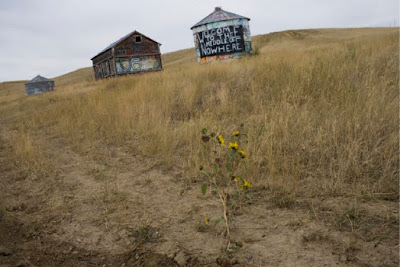
My West is filled with images like these. Ground and sky and the things both present and absent, lending themselves to a singular beauty.


"I have never distinguished readily between thinking and dreaming. I know my life would be much different if I could ever say, This I have learned from my senses, while that I have merely imagined. I will try to tell you the plain truth."
~ Marilynne Robinson, Housekeeping

... A plain truth is this.
There is a value, a weight to a country life.
One of work and struggle, simple pleasures and long odds.
Rural agriculture's actual worth - I cannot say.
But I do know this.
It puts food on the table, and not just our own, that of our neighbors and complete strangers, separated by vast, salty oceans.

Today I attend college in a different part of the west.
Around me are different influences, new ideas and unique environmental challenges specific to the area.
The labor of ranchers, miners, loggers and farmers - while it is the heritage of this place - is looked down upon. Seen often as something brutal, harsh, and ultimately greedy.
Yet, that perspective seems flawed to me.
It tells, a story - but not a complete one.
Perhaps I can share a lens into that west of which I come?
Somewhere between the romantics and the haters, there lies my experience as a farmer's daughter, and my own relationship with the land.

Let us try to see what we can see.


Friday, November 12

Wild Geese


You do not have to be good
You do not have to walk on your knees
for a hundred miles through the desert repenting,
you only have to let the soft animal of your body
loves what it loves.
Tell me about despair, yours, and I will tell you mine.
Meanwhile the world goes on
meanwhile the sun and the clear pebbles of the rain are moving across the landscapes,
over the prairies and the deep trees,
the mountains and the rivers
are heading home again
Whoever you are no matter how lonely,
the world offers itself to your imagination,
call to you like the wild geese, harsh and exciting
over and over announcing your place
in the family of things

~ Mary Oliver

Wednesday, November 10

Reflections West


In the West, there are three things that you can always count on; thistles, wind, and fences. Along roads between homes, towns, and cities of the West you will find, somewhere, a fence line. It may travel with you for miles and miles, or peel away down a canyon, or over a ridge, sharing minimal time in your company, yet quietly reminding you, that man is here.
When tearing fence down on the farm, barbed wire becomes like thistles. Hard to handle, yet always needing dealt with, the more you gather wire off an old fence, the more snagged and bristled with rusty spikes the wild, springy loops become. Kicking down the posts themselves is a different experience, filled with a combative flair, and high chance of victory over rotten, tar covered lumber, the only wood within miles. Years and miles of tumbled down fence, filled every time the wind blows with towering piles of gray thistles; cascading into ditches and at times completely blocking roads in drifts reminiscent of snow. Today I tear these barricades down. Freeing a landscape of its daunting fences.

I am told the Natural Resource Conservation Service wants to protect native grasses and streambeds with fences. To keep the possible stray cattle, sheep, deer or 4 wheelers out. To allow the plants a chance to grow and flourish as they once did, long before I was born. So again I am sent to remote parts of the farm property. This time to build fence. Create a wilderness within boarders.

How to strengthen a boundary, mark off an area, put a land to your use. These things you can come to know. It is something we have done, and continue to do daily to the West. Yet no knowledge I have with fence or land, makes me willing or capable of ever defining a land’s true purpose. Some things even a fence, or lack of fence, cannot do.

second photo by Bill Allard